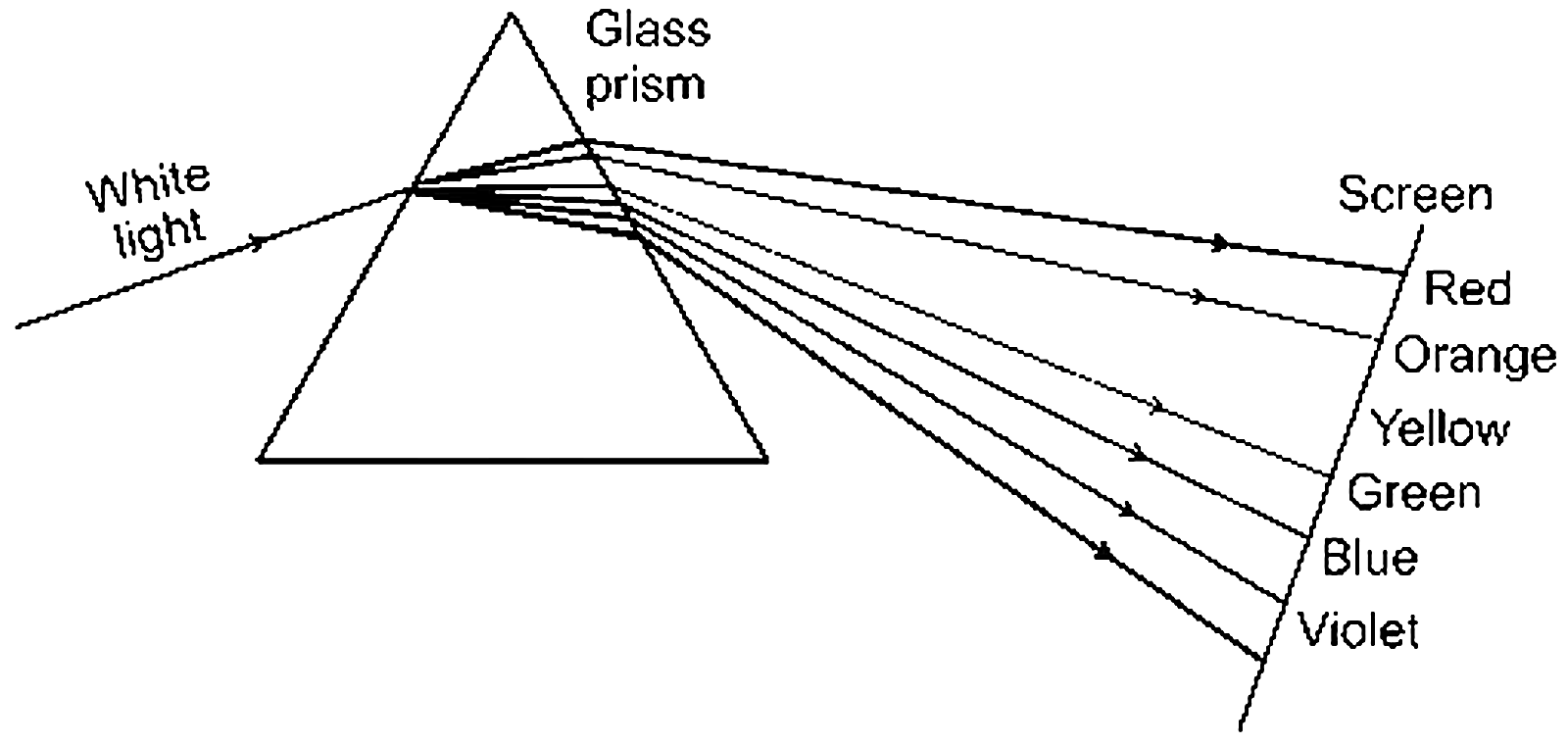
सविस्तर स्पष्टीकरण (Detailed Explanation):
अचूक उत्तर: पर्याय (1)
१. मूलभूत वैज्ञानिक संकल्पना: संयुक्त पांढरा प्रकाश काचेच्या प्रिझममधून जाताना त्याच्या घटक रंगांमध्ये विभाजित होतो. या घटनेला प्रकाशाचे अपस्करण (Dispersion of Light) म्हणतात. यामागील मूलभूत कारण म्हणजे काचेचा अपवर्तनांक प्रकाशाच्या तरंगलांबीनुसार बदलतो. २. कार्यपद्धती व सूत्र: प्रकाशाचा वेग, अपवर्तनांक आणि निर्वातातील प्रकाशाचा वेग यांचा संबंध v = c/n असा आहे. येथे v म्हणजे काचेमधील प्रकाशाचा वेग (m/s), c म्हणजे निर्वातातील प्रकाशाचा वेग (अंदाजे 3 × 10⁸ m/s) आणि n म्हणजे काचेचा अपवर्तनांक (एककविरहित). सामान्य काचेमध्ये जांभळ्या प्रकाशाचा अपवर्तनांक लाल प्रकाशापेक्षा अधिक असतो. त्यामुळे जांभळ्या प्रकाशाचे विचलन अधिक, तर लाल प्रकाशाचे विचलन कमी होते. अशा प्रकारे विविध रंगांचे किरण वेगवेगळ्या दिशांनी बाहेर पडतात. ३. उपयोजन व वैज्ञानिक तथ्य: प्रिझमद्वारे प्रकाशाच्या अपस्करणाचा उपयोग पांढऱ्या प्रकाशातील घटक रंगांचा अभ्यास करण्यासाठी केला जातो. इंद्रधनुष्य हे सूर्यप्रकाशाचे पाण्याच्या थेंबांमध्ये होणारे अपवर्तन, अपस्करण आणि अंतर्गत परावर्तन यांच्याशी संबंधित नैसर्गिक उदाहरण आहे. ही संकल्पना NCERT आणि महाराष्ट्र राज्य मंडळाच्या प्रकाशविषयक अभ्यासक्रमाशी सुसंगत आहे.
1. Fundamental scientific principle: When composite white light passes through a glass prism, it separates into its constituent colours. This phenomenon is called dispersion of light. Its underlying cause is that the refractive index of glass varies with the wavelength of light. 2. Mechanism and formula: The relationship between the speed of light in a medium, its refractive index and the speed of light in vacuum is v = c/n. Here, v is the speed in glass in m/s, c is the speed of light in vacuum (approximately 3 × 10⁸ m/s), and n is the dimensionless refractive index. In ordinary glass, the refractive index for violet light is greater than that for red light. Consequently, violet light deviates more, whereas red light deviates less. The different colours therefore emerge from the prism in different directions. 3. Practical application and textbook connection: A prism is used to study the constituent colours of white light. A rainbow is a natural example involving refraction, dispersion and internal reflection of sunlight in water droplets. These concepts are consistent with the treatment of light in NCERT and Maharashtra State Board science curricula.
स्पष्टीकरण आकृती (Solution Visual Diagram):
अपस्करण (Dispersion), अपवर्तन (Refraction), परावर्तन (Reflection) आणि प्रकीर्णन (Scattering) या वेगवेगळ्या घटना आहेत. अपस्करणामध्ये विविध तरंगलांबींच्या रंगांचे किरण वेगवेगळ्या प्रमाणात वळतात. सामान्य काचेमध्ये जांभळ्या रंगाचे विचलन सर्वाधिक आणि लाल रंगाचे विचलन सर्वांत कमी असते. प्रकाशाचा वेग बदलणे हे महत्त्वाचे असले, तरी केवळ वेगातील फरक एवढेच स्पष्टीकरण न देता अपवर्तनांकाचा तरंगलांबीशी असलेला संबंध लक्षात ठेवावा.
Do not confuse dispersion, refraction, reflection and scattering. Refraction is the change in direction of light when it passes between media with different refractive indices. Dispersion is the separation of different wavelengths because their refractive indices and deviations differ. In ordinary glass under normal dispersion, violet light deviates the most and red light the least. A scientifically complete explanation identifies the wavelength dependence of refractive index, rather than merely stating that the colours travel at different speeds.
ROYGBIV ही इंग्रजी स्मृतीक्लृप्ती लक्षात ठेवा: Red, Orange, Yellow, Green, Blue, Indigo, Violet. मराठीत क्रम: लाल, नारिंगी, पिवळा, हिरवा, निळा, पारवा आणि जांभळा. सामान्य काचेमध्ये लाल रंगाचे विचलन सर्वांत कमी आणि जांभळ्या रंगाचे सर्वांत जास्त असते.
Remember ROYGBIV: Red, Orange, Yellow, Green, Blue, Indigo, Violet. In a typical glass prism, red deviates least and violet deviates most. Associate red with the least deviation and violet with the greatest deviation.
पर्याय २ चुकीचा आहे, कारण सर्व रंगांचा अपवर्तनांक समान नसतो आणि त्यामुळे त्यांचे विचलनही समान होत नाही. पर्याय ३ चुकीचा आहे, कारण परावर्तन म्हणजे प्रकाशकिरण पृष्ठभागावरून परत जाणे; प्रिझममधील अपस्करणाचे प्रमुख कारण परावर्तन नसून तरंगलांबीनुसार बदलणारा अपवर्तनांक आहे. पर्याय ४ चुकीचा आहे, कारण प्रकीर्णन म्हणजे कणांमुळे प्रकाशाचे विविध दिशांनी विखुरणे. प्रिझममधील रंगविभाजन ही प्रकीर्णनाची घटना नसून अपवर्तनांकातील तरंगलांबीनुसार होणाऱ्या बदलामुळे निर्माण होणारे अपस्करण आहे.
Option 2 is incorrect because the refractive index is not the same for all visible wavelengths in ordinary glass; consequently, the colours do not undergo equal deviation. Option 3 is incorrect because reflection is the return of light from a surface, whereas dispersion in a prism primarily results from wavelength-dependent refraction. Option 4 is incorrect because scattering is the redirection of light by particles or irregularities. The separation of colours by a prism is dispersion, not scattering.