सविस्तर स्पष्टीकरण (Detailed Explanation):
अचूक उत्तर: पर्याय (2)
दिलेले आहे:
आपल्याला 50 पेक्षा लहान मूळ संख्यांची एकूण संख्या शोधायची आहे.
वापरलेले सूत्र:
मूळ संख्या ही 1 पेक्षा मोठी नैसर्गिक संख्या असते, जिला 1 आणि ती संख्या स्वतः व्यतिरिक्त कोणतेही धन विभाजक नसतात.
गणना:
50 पेक्षा लहान मूळ संख्यांची यादी: 2, 3, 5, 7, 11, 13, 17, 19, 23, 29, 31, 37, 41, 43, 47
50 पेक्षा लहान मूळ संख्यांची एकूण संख्या = 15
50 पेक्षा लहान मूळ संख्यांची एकूण संख्या 15 आहे.
Shortcut Trick
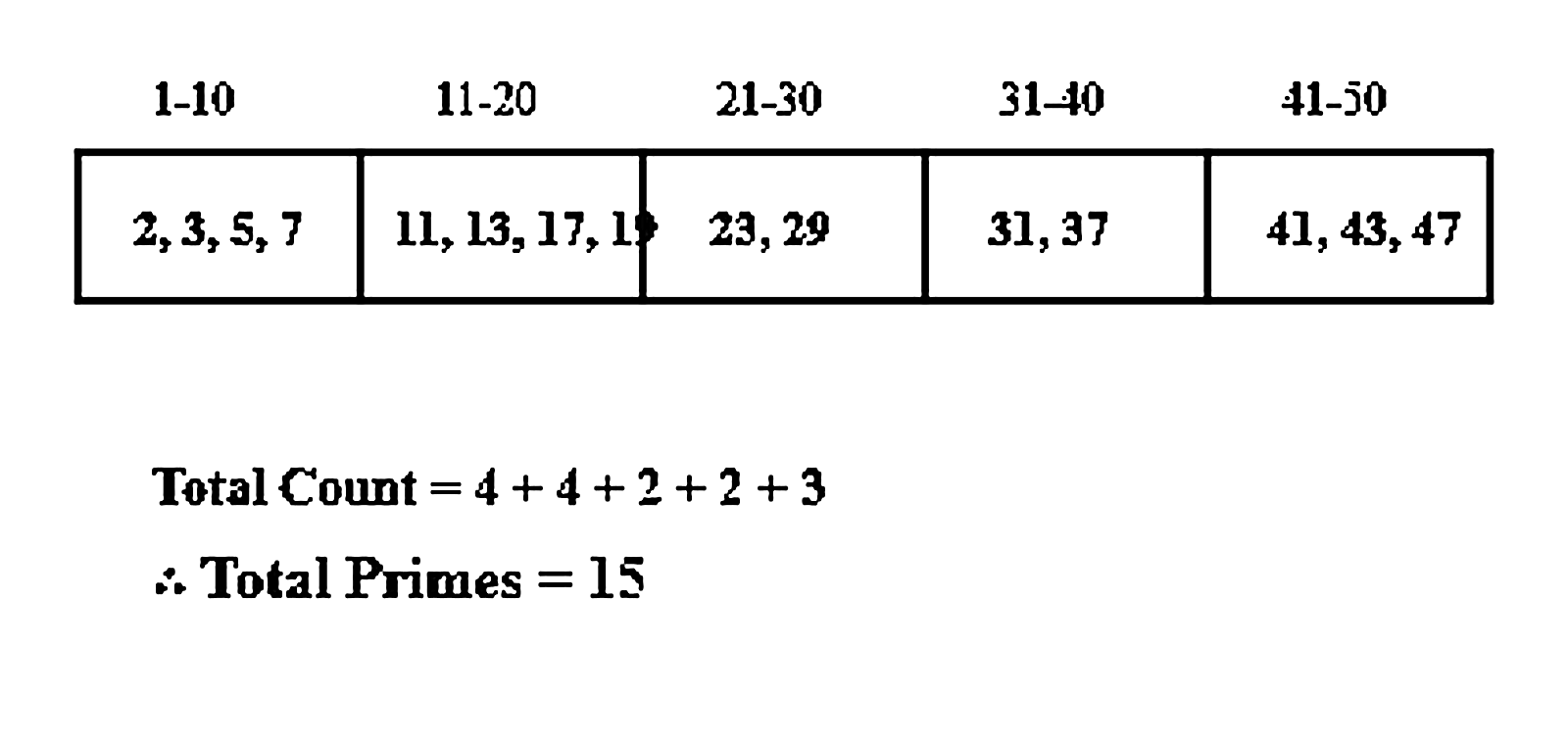
To find prime numbers quickly, use the standard count in ranges of 10.
Numbers 1 to 10: 4 primes (2, 3, 5, 7)
Numbers 11 to 20: 4 primes (11, 13, 17, 19)
Numbers 21 to 30: 2 primes (23, 29)
Numbers 31 to 40: 2 primes (31, 37)
Numbers 41 to 50: 3 primes (41, 43, 47)
Total primes = 4 + 4 + 2 + 2 + 3 = 15
∴ The correct answer is 15.
Alternate Method
Given: Find all prime numbers less than 50.
A prime number is a natural number greater than 1 that has no positive divisors other than 1 and itself.
⇒ Prime numbers between 1 and 10: 2, 3, 5, 7 (Total 4)
⇒ Prime numbers between 11 and 20: 11, 13, 17, 19 (Total 4)
⇒ Prime numbers between 21 and 30: 23, 29 (Total 2)
⇒ Prime numbers between 31 and 40: 31, 37 (Total 2)
⇒ Prime numbers between 41 and 50: 41, 43, 47 (Total 3)
⇒ Total count = 4 + 4 + 2 + 2 + 3 = 15
∴ The correct answer is 15.
Related Concepts:
Definition of Prime Numbers
A number that is divisible only by 1 and itself. 1 is neither prime nor composite.
Smallest Prime Number
2 is the smallest prime number and the only even prime number.
Primes up to 100
There are a total of 25 prime numbers between 1 and 100 (15 primes up to 50 and 10 primes from 51 to 100).
Co-prime Numbers
Two numbers are co-prime if their Highest Common Factor (HCF) is 1.
स्पष्टीकरण आकृती (Solution Visual Diagram):
Solution Diagram